
Programming Jobs Are (mostly) Going Away
Tech leadership needs to stop pretending that means everyone else is next

I think it’s likely that around 95% of today’s programming and software testing jobs will be gone within the next five to seven years. Not transformed. Not “AI-assisted.” Gone.1
What worries me isn’t that prediction. What worries me is watching high-tech leadership panic and immediately jump to the wrong conclusion: that if programming collapses, then most jobs must be doomed too.
That leap is not insight. It’s a category error driven by ego.
Tech is not the economy. It’s an industry. A powerful one - but still just one. And right now, it’s the industry staring down the barrel of massive automation.
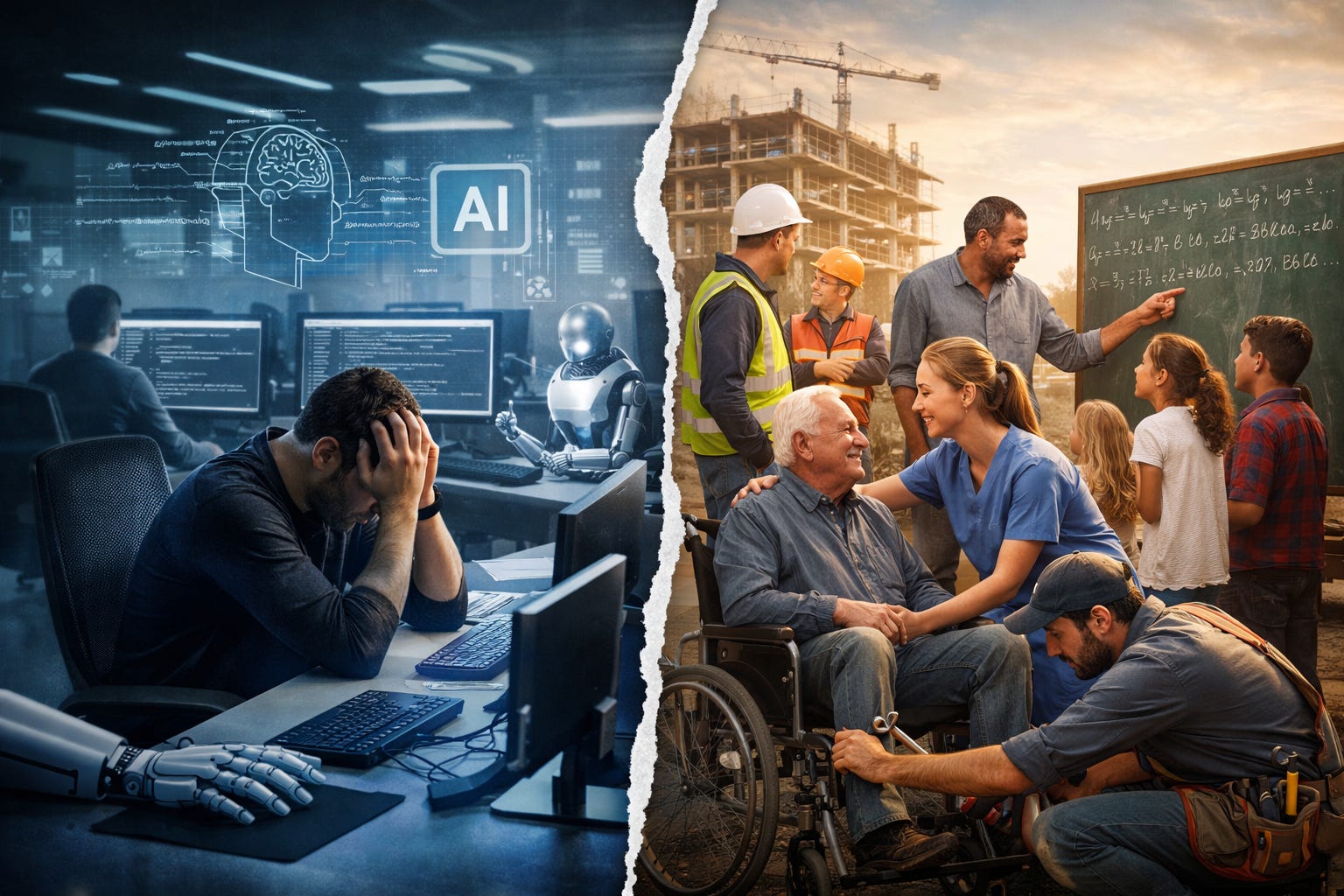
What “95% gone” actually means - and what it doesn’t
Let’s get something straight, because people keep either minimizing this or exaggerating it.
I am not saying software stops being written. I am saying the number of humans required to write, test, and maintain software collapses.
Once AI is:
good enough,
fast enough,
cheap enough,
and always on,
the labor math breaks. Software development today employs huge numbers of people because humans were the bottleneck. AI removes that bottleneck.
That wipes out:
routine implementation,
boilerplate code,
test creation and maintenance,
regression testing,
refactoring at scale,
ticket-driven “move this from A to B” work.
When one competent engineer with AI can do what entire teams used to do, companies don’t preserve jobs out of sentiment. They reduce headcount. Permanently.
That’s how automation works. Every time.
The leadership mistake: confusing “my collapse” with “the collapse”
Here’s where tech leadership loses the plot.
Because their industry is facing a labor implosion, they assume all industries must be next. Suddenly it’s “the end of work,” “universal joblessness,” or “AI replaces everyone.”
This is what happens when you spend 20 years believing your sector is the center of reality.
Most of the economy is constrained by things AI doesn’t erase:
physical presence,
licensing and regulation,
legal liability,
human trust,
real-world responsibility when something goes wrong.
AI will change medicine without replacing doctors.
It will change construction without eliminating builders.
It will change energy without removing electricians.
It will change education without eliminating teachers.
Software is different because software is pure abstraction. Once intelligence itself becomes cheap, software labor collapses faster than almost anything else.
That does not generalize cleanly to the rest of the economy.
Why software gets hit harder than almost any field
This isn’t magic. It’s structure.
Software work is unusually vulnerable because:
the output is digital,
the inputs are digital,
the feedback loop is digital,
and the entire system is already machine-readable.
That makes it the perfect target for automation.
Testing is even more exposed. Once AI can generate code, it can generate tests, mutate them, run them continuously, and reason about coverage faster than any human team ever could. Human testers don’t disappear, but they become rare specialists, not armies.
This is why 95% is plausible. Not because humans become useless, but because far fewer are needed.
Leadership needs to calm down - and think clearly
Here’s the message tech leaders need to hear:
The collapse of programming jobs is not proof that society is running out of work. It’s proof that your industry is no longer labor-intensive.
That’s it.
Every industry eventually hits this point. Manufacturing did. Agriculture did. Clerical work did. Drafting did. Telecom did. Tech just convinced itself it was exempt.
What’s actually happening is that software is becoming infrastructure, not a craft practiced by massive workforces. Infrastructure employs fewer people once it matures. Always has.
Yes, this transition will be brutal - but it’s contained
Let’s not sugarcoat this. For people inside tech, especially:
new grads,
bootcamp grads,
offshore teams,
mid-level generalists,
this will be ugly.2
Entire career paths shrink or vanish. Not because people failed, but because the economic justification disappears.
But leadership needs to stop projecting that pain outward and declaring the end of employment itself. That’s fear talking, not analysis.
What leaders should actually be doing
Instead of panicking, tech leadership should be doing three things:
Stop selling apocalypse narratives. They’re inaccurate and self-centered.
Plan for a much smaller, more senior technical workforce. Fewer implementers, more decision-makers.
Be honest: software headcount is not coming back, but that doesn’t mean the economy is collapsing.
The mistake isn’t predicting massive job loss in programming.
The mistake is assuming that because we are being disrupted, everyone must be.
We spent decades telling other industries to adapt or die.3
Now it’s our turn - and leadership needs to face that reality without dragging the rest of the economy into our panic.
Claude CODE today can probably replace 50% - 80% of programming work. The time needed is more to get companies to adapt, not for further A.I. improvements.
Personally this sucks. I’m an incredibly good programmer. And I’ve learned a wide breadth of the tech stack. And now… worthless. I’m not trying to downplay the same pain millions of others in the industry are feeling over this.
Karmic justice?